
Understanding Dental Abscesses: Professional Care at Dental Nook
Table of Contents
What Is A Tooth Abscess?
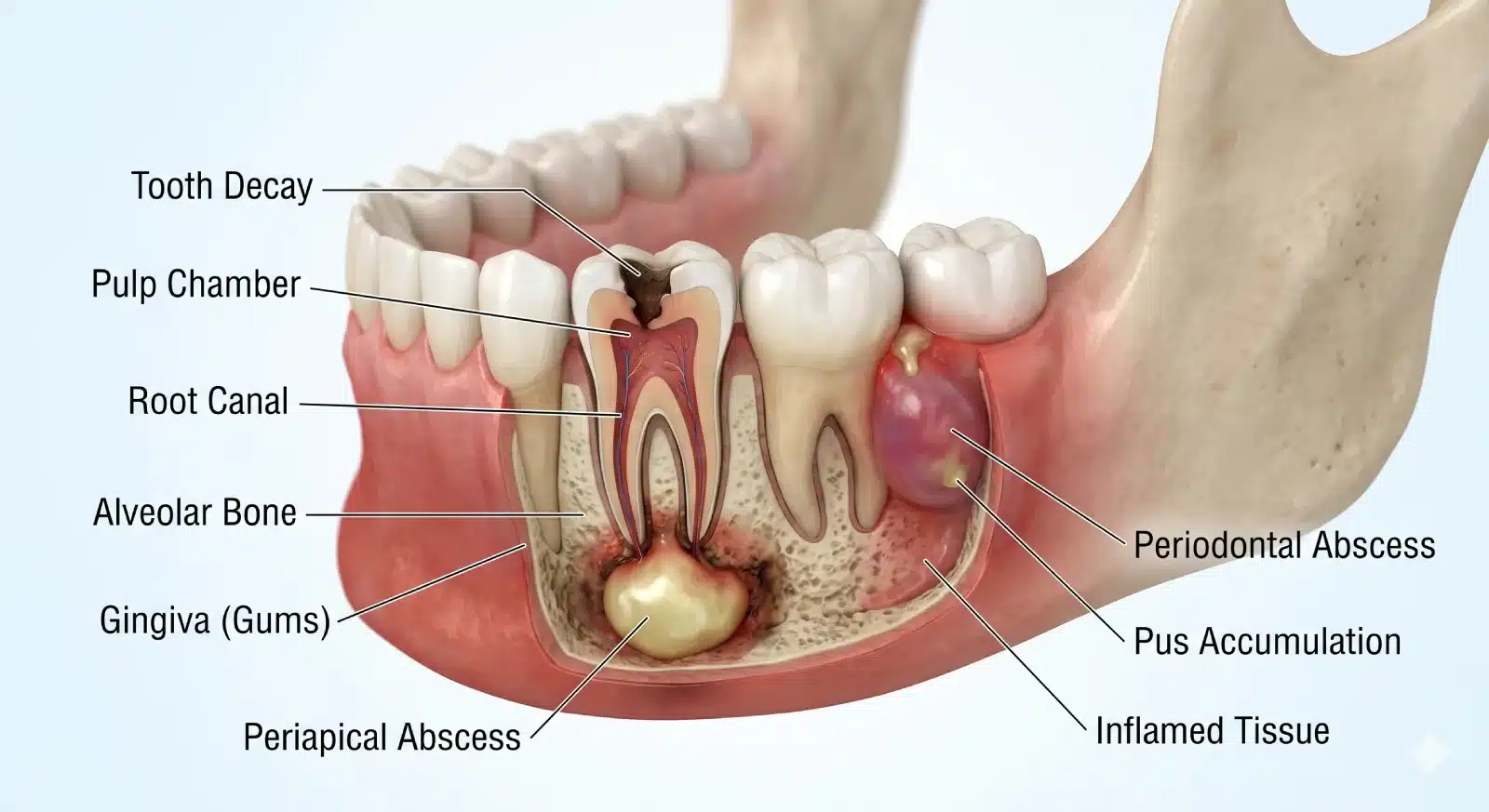
A dental abscess is not just a painful inconvenience — it is a serious bacterial infection that demands prompt professional attention. At its core, an abscess is a sealed pocket of pus that forms when bacteria invade the inner structures of a tooth or the surrounding gum tissue, and the body’s immune response cannot clear the infection on its own. The pus must be properly drained and the source of infection eliminated by a dentist; it will not resolve without treatment.
Most dental abscesses trace back to untreated tooth decay, but a crack, chip, or physical injury that opens a pathway into the tooth can trigger the same outcome. Depending on exactly where the infection takes hold, abscesses are classified into two types. A periapical abscess originates at the very tip of the tooth root, while a periodontal abscess develops in the gum tissue running alongside the root.
What Causes A Tooth Abscess?
Two conditions need to align for a dental abscess to develop: a point of bacterial entry, and an opportunity for those bacteria to reach the vulnerable interior of the tooth.
When tooth decay is left unaddressed, it carves a path through the protective enamel and dentin layers, eventually reaching the pulp — the living tissue at the heart of every tooth. Once bacteria colonise this inner chamber, the infection takes hold rapidly. The result is relentless, deep-seated pain that does not come and go like ordinary sensitivity — it is persistent, often throbbing, and can radiate outward. Without treatment, the infection does not stay confined to one tooth; it can travel to adjacent teeth and, in serious cases, spread systemically through the body.
What Are The Stages of A Tooth Abscess?
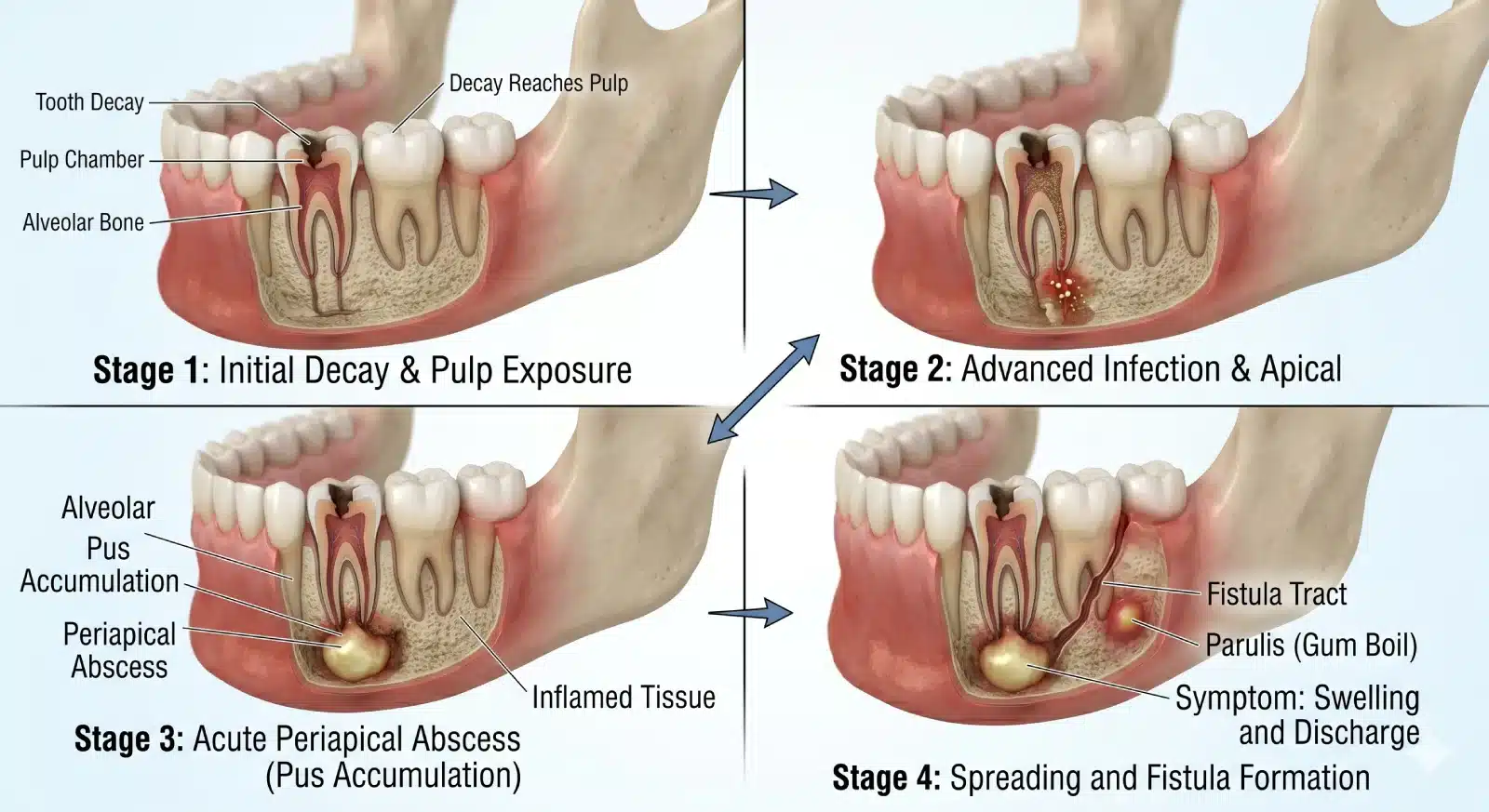
A dental abscess progresses through three distinct phases, each more serious than the one before:
- Tooth Decay — It begins at the surface. Bacterial plaque accumulates on the tooth, producing acids that gradually erode the enamel and open a cavity. Once bacteria establish themselves inside that cavity, they continue dissolving the tooth from within. When they breach the hard outer layers and reach the softer dentin, the path to the pulp is no longer far.
- Pulp Infection — With bacteria now inside the pulp chamber, the nerve tissue becomes agitated and inflamed. The immune system mobilises, but rather than clearing the infection, the inflammatory response produces pus that accumulates around the root tip. This trapped pressure presses outward against the surrounding bone and tissue, producing the characteristic throbbing pain and visible swelling associated with a tooth abscess.
- Spread of Infection — When the first two stages go unaddressed, the infection outgrows its original location and begins invading neighbouring structures. The jawbone is particularly vulnerable at this point, and bone erosion can begin. In the most severe cases, the infection enters the bloodstream, at which point it becomes a genuine medical emergency.
Symptoms of A Tooth Abscess
The warning signs of a dental abscess are often hard to miss, though some cases develop more quietly than others. Common indicators include:
- Heightened sensitivity to temperature — both heat and cold
- Pain when biting, chewing, or applying any pressure to the tooth
- A persistent, deep ache that radiates into the jaw, neck, or ear
- Visible swelling in the cheek or face
- Tender or enlarged lymph nodes beneath the jaw or in the neck
- Difficulty swallowing or breathing — a sign requiring immediate emergency care
- A sudden flood of salty liquid into the mouth accompanied by a rapid drop in pain, which indicates the abscess has burst spontaneously
Treatment Options for A Tooth Abscess
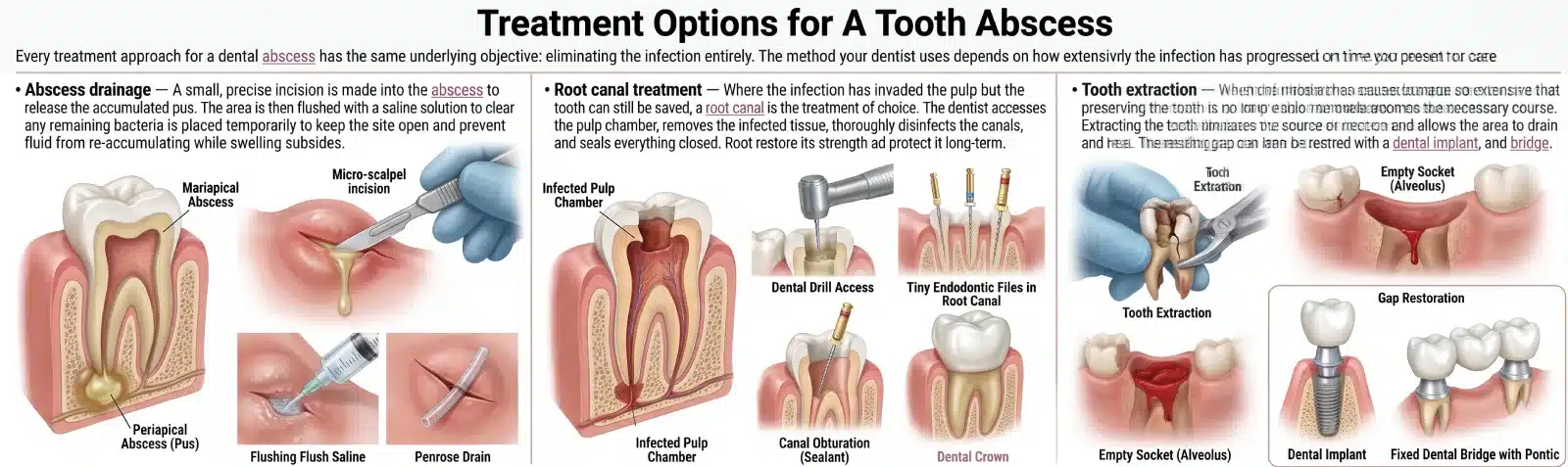
Every treatment approach for a dental abscess has the same underlying objective: eliminating the infection entirely. The method your dentist uses depends on how extensively the infection has progressed by the time you present for care
- Abscess drainage — A small, precise incision is made into the abscess to release the accumulated pus. The area is then flushed with a saline solution to clear any remaining bacteria. In some cases, a tiny rubber drain is placed temporarily to keep the site open and prevent fluid from re-accumulating while swelling subsides.
- Root canal treatment — Where the infection has invaded the pulp but the tooth can still be saved, a root canal is the treatment of choice. The dentist accesses the pulp chamber, removes the infected tissue, thoroughly disinfects the canals, and seals everything closed. A dental crown is typically placed over the treated tooth to restore its strength and protect it long-term. Root canal treatment gives dentists the best chance of preserving a tooth that would otherwise be lost.
- Tooth extraction — When the infection has caused damage so extensive that preserving the tooth is no longer viable, removal becomes the necessary course. Extracting the tooth eliminates the source of infection and allows the area to drain and heal. The resulting gap can later be restored with a dental implant, bridge, or other suitable replacement.
In situations where the infection has migrated beyond the tooth — affecting the jaw, surrounding teeth, or soft tissues — antibiotics will be prescribed alongside the dental procedure to halt further spread. They may also be used when a patient’s immune system is compromised. Commonly prescribed antibiotics for dental abscesses include Amoxicillin, Metronidazole, Penicillin, Azithromycin, and Cefoxitin. Antibiotics alone, however, cannot resolve a dental abscess — they manage the systemic component, but the physical source of infection must still be treated by your dentist. Always discuss medications with your treating clinician, as individual allergies and sensitivities vary.
Dental Abscess Complications
The greatest risk with a dental abscess is not the abscess itself — it is what happens when it is ignored. Bacteria are remarkably resourceful at finding new territory to occupy. Left without treatment, a dental abscess can give rise to a range of serious and sometimes life-threatening complications:
- Jaw cysts (oral cysts) — Fluid-filled sacs can develop within the jawbone as the infection takes hold of the surrounding bone tissue. These require surgical removal.
- Osteomyelitis — If bacteria penetrate the bloodstream, they can infect bone elsewhere in the body, a painful and difficult-to-treat condition.
- Cavernous sinus thrombosis — A rare but potentially fatal complication in which a blood clot forms in the large venous channel at the base of the skull, caused by bacteria tracking upward from an untreated dental infection.
- Ludwig’s angina — A rapidly spreading bacterial infection of the floor of the mouth that can obstruct the airway and constitutes a medical emergency.
- Maxillary sinusitis — Infection that reaches the sinus cavities behind the cheekbones, causing pressure, pain, and nasal congestion.
None of these outcomes are inevitable. They are the result of delayed care. Treating an abscess promptly and decisively avoids this entire cascade.
What If An Abscess Bursts On Its Own?
Occasionally, the pressure inside an abscess builds to the point where it ruptures without any intervention. You will know this has happened by a sudden rush of salty, unpleasant-tasting fluid into your mouth, followed by a notable reduction in pain as the pressure releases. Do not mistake that relief for a resolution — the infection is still very much present and needs professional treatment.
In the immediate aftermath of a spontaneous rupture, rinse your mouth thoroughly with either warm salt water or a diluted hydrogen peroxide solution for around two minutes, then spit it out completely. A cold pack held against the outer cheek can help manage any residual discomfort. Arrange a dental appointment as soon as possible regardless of how much better you feel.
Discussing A Tooth Abscess With Children
When a child is dealing with a dental abscess, the experience can feel frightening and overwhelming — for both the child and the parent. Children generally cope best when they understand what is happening and what to expect. Rather than shielding them from the situation entirely or presenting it as something alarming, give them an age-appropriate explanation of what the problem is and what the dentist will do to fix it. Keep the language simple and reassuring, leave space for them to ask questions, and listen to their concerns without dismissing them.
Let your child know that the dentist is there to help them feel better, and that it is perfectly fine to ask the dentist questions too. At Dental Nook, our team is experienced in putting young patients at ease and making dental visits as calm and positive as possible.
Can I Drain An Abscess Without A Dentist?
Various home remedies circulate online claiming to drain or resolve a dental abscess, but none of them can do what professional treatment does. A dentist uses dental X-rays and clinical assessment to establish precisely how far the infection has spread — information that is simply not available from outside the mouth. Without that knowledge, any attempt to manage an abscess at home carries real risk of making the situation worse by spreading the infection further.
If dental anxiety is what is keeping you from seeking care, it is important to weigh that against the genuine dangers of leaving an abscess untreated. At Dental Nook, we offer options including happy gas and sleep dentistry to make your experience as comfortable as possible — you do not have to face it without support.
Before Seeing A Dentist
If you suspect you or someone in your family has a dental abscess, book an appointment immediately — do not wait for symptoms to escalate. While you are preparing for your visit, it can help to:
- Write down every symptom you are experiencing, even those that seem unrelated to your tooth
- Make a note of all current medications and any known allergies
- Note when the pain or symptoms first started and whether anything makes them better or worse
- Prepare any questions you want to ask your dentist
Useful questions to consider asking include:
- What is the most likely cause of my symptoms?
- What treatment do you recommend, and what does it involve?
- Are there any activities or foods I should avoid while this heals?
- Is there anything I can read or access to better understand my condition?
Preventing A Tooth Abscess
An abscess is the endpoint of a process that begins long before — which means it is almost always preventable. The mechanics are straightforward: keep bacteria under control, give decay no opportunity to establish itself, and attend regular dental check-ups so any early warning signs are caught before they escalate. Practically, this means brushing at least twice daily, flossing every day, limiting sugar intake, swapping your toothbrush every three to four months, and adding a fluoride or antibacterial mouth rinse to your routine for extra protection. Consistent, unremarkable daily habits are what keep dental abscesses firmly in the category of things that happen to other people.
Dental Abscess Treatment at Dental Nook
If you think you or your child may have a dental abscess, do not delay — contact Dental Nook to arrange an appointment as soon as possible. We provide comprehensive dental care for patients of all ages, including options for anxious patients such as happy gas and treatment under general anaesthesia. Our team uses current technology, quality materials, and straightforward honest advice — because getting you out of pain and back to full health is what we are here for.