
Dental Bridges for Missing Teeth: Dental Nook
Frequently Asked Questions
What are the advantages of dental bridges?
What are the disadvantages of dental bridges?
Can you put a bridge on your front teeth?
Front teeth experience considerably less biting force than molars, which actually opens up more bridging options for that area. Suitable front-tooth bridge solutions include:
- Traditional bridges
- Maryland bonded bridges
- Cantilever bridges
How long after extraction can I get a dental bridge?
Do dental bridges look natural?
How often should a dental bridge be replaced?
Are dental bridges bad for teeth?
What is a Dental Bridge?
What are the Types of Dental Bridges Available?
Four main bridge designs are used in modern dentistry:
- Traditional
- Maryland-bonded
- Cantilever
- Implant-supported
Traditional Dental Bridge

The traditional bridge is the most widely used design and one of the most time-efficient ways to address a missing tooth. The structure is straightforward: a pontic sits in the centre, flanked by a crown on each side that is cemented onto the prepared abutment teeth. Materials typically include porcelain fused to metal, all-ceramic, or all-metal options such as gold.
To fit a traditional bridge, the dentist needs to reshape the abutment teeth by removing a layer of enamel so the crowns seat correctly — this is an irreversible step and worth discussing fully before committing. This type of bridge works best when there are healthy natural teeth present on both sides of the gap. For larger spans with multiple consecutive missing teeth, dentures may be a more practical consideration. Traditional bridges perform especially well in the back of the mouth where bite forces are greatest, and with proper care they can be a very durable long-term solution.
Maryland-Bonded Dental Bridge
The Maryland bridge was designed with conservation in mind. Rather than placing full crowns over the abutment teeth, this design uses a pontic attached to thin porcelain or metal wings that are bonded discreetly to the inner surfaces of the adjacent teeth. Because the wings attach to the backs of the teeth, very little — if any — enamel removal is required, making this a far less invasive procedure.
Contemporary Maryland bridges predominantly use porcelain wings rather than metal ones, since porcelain is less visible and blends better with the surrounding dentition. This style is best suited to the front teeth, where bite forces are gentler. It is generally not recommended for canines or teeth that bear heavier functional loads, as the bonded wings can become dislodged under repeated pressure.
Cantilever Dental Bridge
A cantilever bridge follows a similar construction to a traditional bridge, but with one key difference — the pontic is supported by a crown on only one side rather than two. This makes it a viable option when there is only a single natural tooth adjacent to the gap.
Because all the load is carried through one crown rather than shared across two, the fit of that crown needs to be precise, and some enamel preparation of the abutment tooth is still required. Cantilever bridges are best reserved for the front teeth, where the forces involved are manageable. They are not recommended for molar regions where biting pressure would place too much stress on the single supporting tooth.
Implant-Supported Dental Bridge
Unlike the other designs, an implant-supported bridge requires no natural teeth as anchors at all. Instead, titanium implants are surgically placed into the jawbone, and the bridge is mounted directly onto those implants. This approach is particularly well-suited to patients who are missing three or more consecutive teeth at the back of the mouth.
The process is split across two surgical stages — the first to place the implants and allow them to integrate with the jawbone, and the second to attach the bridge once healing is complete. While the timeline is longer, the outcome is a restoration anchored directly into the bone, which preserves jaw structure and eliminates the need to involve surrounding teeth entirely.
Who Needs Dental Bridges?
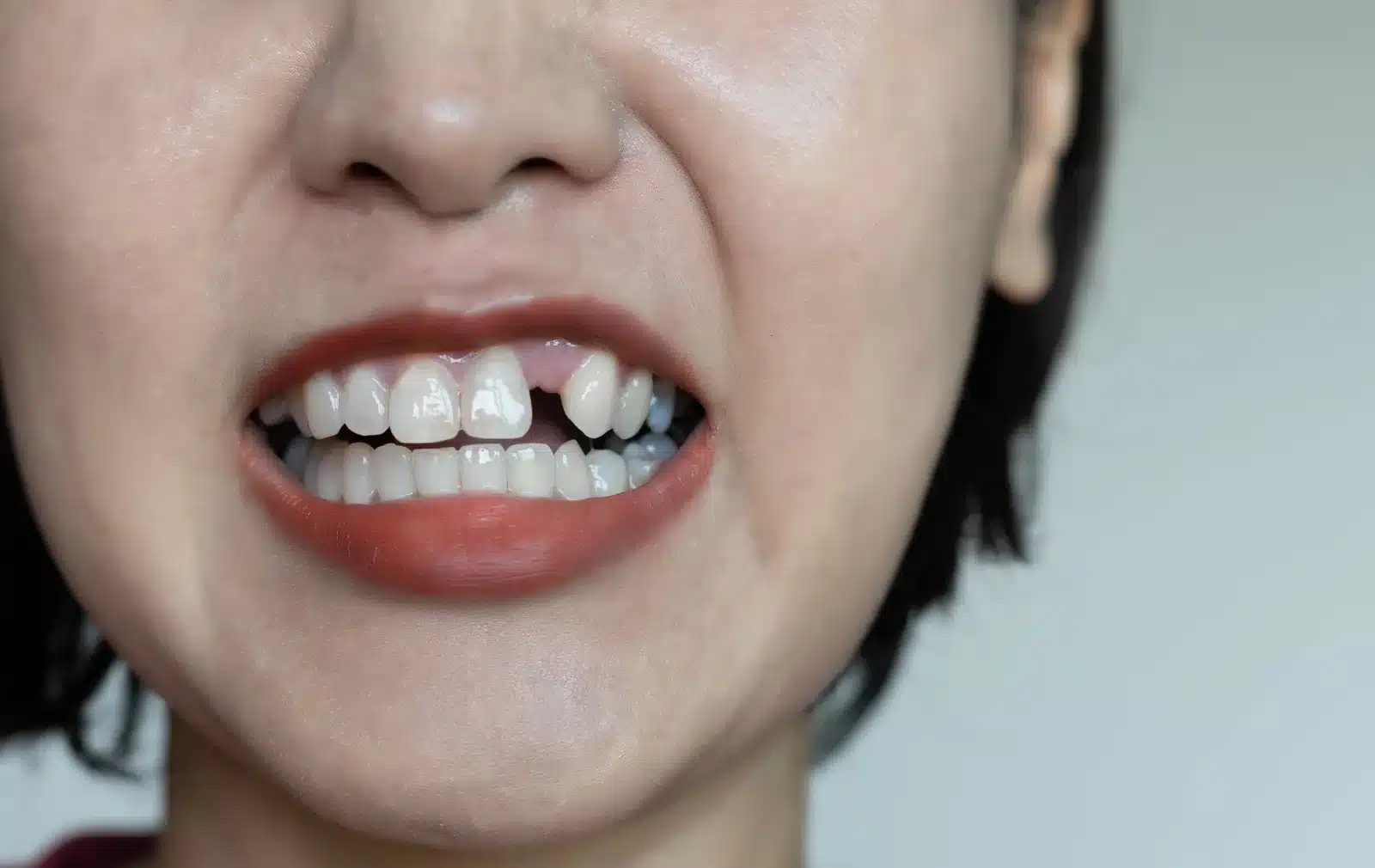
Tooth loss is far more common than many people realise — Australian adults are missing an average of 4.5 teeth. A dental bridge is worth considering if any of the following apply to you:
- You have lost teeth as a result of injury, decay, or gum disease
- You were born with congenitally missing teeth
- You want to bring back the fullness and symmetry of your smile
- Chewing comfortably has become difficult or painful
- You want to stop the surrounding teeth from shifting out of alignment
- You need your bite rebalanced to distribute chewing forces more evenly
- Tooth loss has begun to affect your speech or pronunciation
Procedure for a Dental Bridge
Step 1: Preparing the Abutment Teeth and Placing a Temporary Bridge
At your first appointment, the dentist administers local anaesthetic and carefully reshapes the abutment teeth, removing just enough enamel to allow the crowns to seat flush and naturally. Precise impressions are then taken and sent to a dental laboratory where your custom bridge is fabricated.
In the meantime, a temporary bridge is placed over the prepared teeth to protect them and maintain the aesthetics of your smile. This interim stage also lets the dentist assess whether the abutment teeth are structurally strong enough to carry a permanent bridge long-term. If they are not, the treatment plan may pivot toward an implant-supported solution instead.
Step 2: Fitting the Permanent Bridge
Once the laboratory has completed your bridge, you return for the second appointment. The temporary bridge comes off first, and the teeth are cleaned and examined. If any sensitivity is present, a local anaesthetic is applied before the final fitting begins.
The permanent bridge is carefully seated, and dental X-rays are taken to confirm the fit is accurate and the contacts are correct. Once the dentist is satisfied with the result, the bridge is bonded to the abutment teeth using dental cement — and the restoration is complete.
How Should You Care for Your Dental Bridge?
Maintaining Oral Hygiene
Eating Healthy Diets
Regular Professional Cleanups
Even with diligent home care, having a dentist or hygienist professionally clean around your bridge at regular intervals makes a significant difference. Calculus builds up in areas that are hard to reach at home, and early signs of decay or gum changes around the abutment teeth are far easier to manage when caught early.
A gap in your smile does not have to be permanent, and it does not have to disrupt your confidence or your quality of life. With the right bridge solution and a commitment to looking after it properly, you can restore your mouth to full function and get back to eating, speaking, and smiling without a second thought.
At Dental Nook, our team is here to guide you through every step of the process — from helping you choose the most suitable bridge type through to long-term care. Get in touch today to arrange a consultation.