
Twilight Sedation Dentist

Twilight sedation — also referred to as conscious sedation — is a form of anaesthesia used during dental procedures. It works by combining two types of medication: one to ease anxiety and promote relaxation (a sedative) and one to minimise discomfort (a pain-relieving agent). The patient remains conscious throughout but enters a deeply relaxed state, and most people retain little or no memory of the procedure once it is over. This approach is particularly well-suited to patients who experience dental anxiety or who are facing complex or lengthy dental treatments.
Unlike sleep dentistry under full general anaesthesia, twilight sedation does not render the patient completely unconscious, making it a practical alternative for a broad range of procedures. It is widely used for complex dental work, patients with anxiety around dental visits, or those with particular medical or behavioural needs. The depth of effect varies but typically includes a sense of calm, partial or complete amnesia of the treatment, and reduced sensitivity to discomfort. The medication can be delivered via several routes — intravenous (IV), oral, or inhalation. Throughout the procedure, the patient’s vital signs are carefully tracked to maintain safety, and recovery following twilight sedation is generally faster than with general anaesthesia.

What Is Dental Sedation?

Dental sedation is a technique used by dentists to create a calm, stress-free environment for patients during treatment. Through the use of carefully selected medications, it helps patients feel at ease in the dental chair, even during procedures they might otherwise find distressing.
There are several levels of sedation, each suited to different circumstances:
Minimal sedation: The patient is fully awake but feels noticeably relaxed.
Moderate sedation: The patient may speak with some slurring and is unlikely to recall much of the procedure.
Deep sedation: The patient is on the boundary of consciousness but can still be roused if needed.
General anaesthesia: The patient is fully unconscious and completely unaware throughout.
Sedation can be administered in different ways: through inhalation (nitrous oxide gas), orally (via a tablet or liquid), or intravenously, where the sedative is introduced directly into the bloodstream for a more immediate and controllable effect. In some paediatric cases, an oral sedative may be given to children prior to general anaesthesia to ease them into the process more gently.
It is worth emphasising that sedation is considered safe when it is delivered and overseen by qualified, experienced sedationists or anaesthetists.
For patients who struggle with dental anxiety, sedation dentistry can be genuinely life-changing — enabling them to access the care they need without the fear and stress that may have held them back.

How Twilight Dentistry Supports Dental Anxiety

Twilight dentistry, or conscious sedation, is designed to keep patients calm and comfortable throughout their dental appointment. Unlike full general anaesthesia, patients under twilight sedation remain aware but settle into a state of profound relaxation — sometimes described as a dream-like feeling. This makes it especially valuable for anxious patients or those undergoing more involved procedures. It is important to note that while the treatment itself is designed to be pain-free, some degree of post-procedure soreness is normal during the healing period after surgery.

The Advantages of IV Sedation in Dental Treatment

IV sedation offers a number of meaningful benefits when incorporated into dental care. It promotes a deep sense of calm, alleviating anxiety and helping patients feel comfortable from start to finish. It is a proven, safe option across a wide spectrum of procedures — from routine dental work through to more complex treatments such as dental implants, root canal therapy, or wisdom tooth extraction. Our practice offers IV sedation to ensure that every patient has a relaxed, comfortable experience regardless of the complexity of their treatment.

What to Expect During a Twilight Sedation Appointment
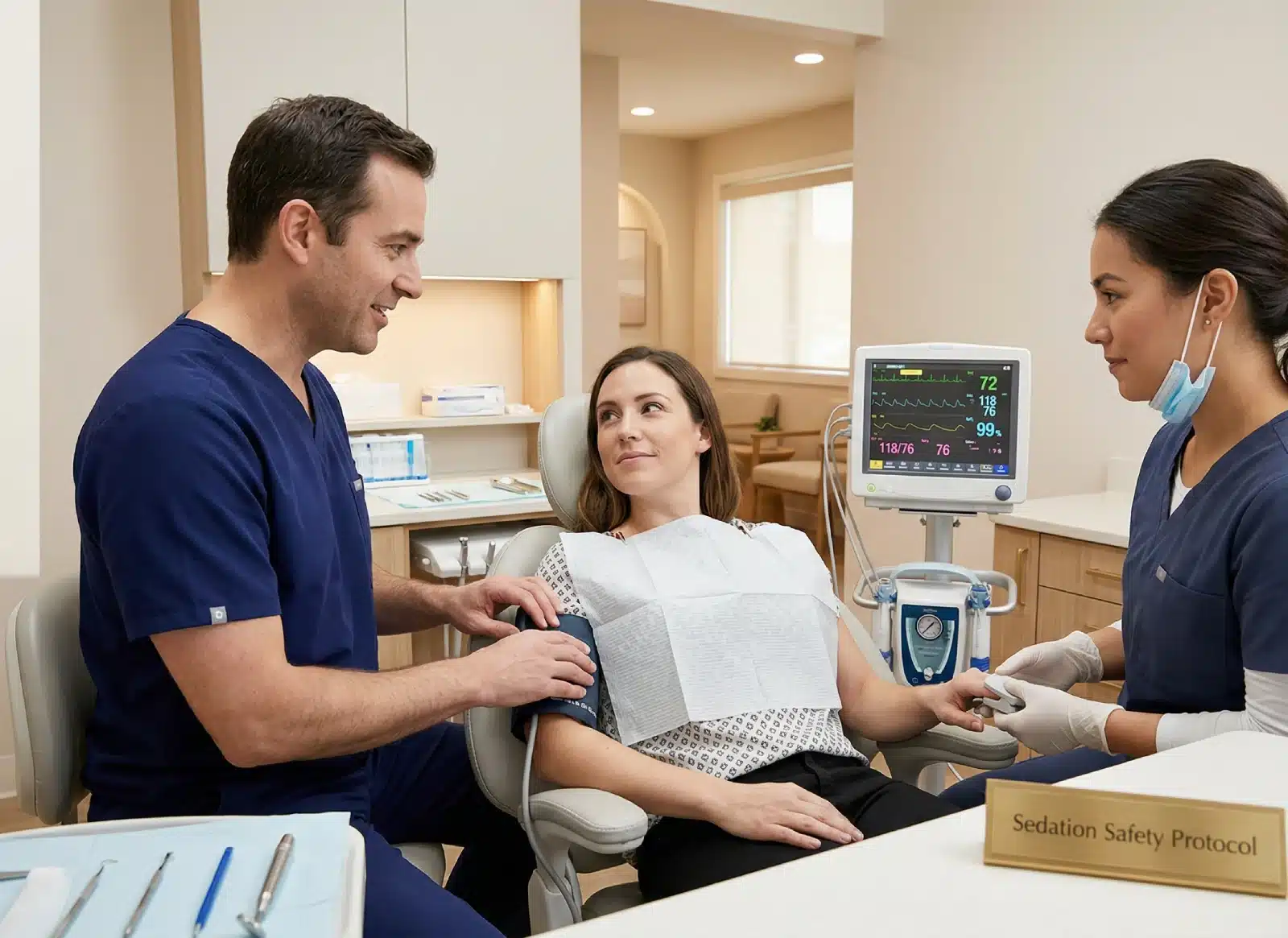
When you arrive for a sedation appointment, our attentive team will go over your medical history and walk you through what to expect from the sedation process. You will be settled comfortably into the treatment chair, and monitoring equipment will be placed to track your blood pressure, heart rate, and other vital signs throughout the appointment.
For IV sedation, a fine needle is used to introduce the sedative directly into a vein, bringing on a state of deep relaxation quickly and smoothly. You will remain conscious but in a calm, hazy state, fully at ease while the dental work is carried out. Depending on how much treatment is required, multiple procedures may be completed in a single visit, which can significantly reduce the number of appointments needed overall.

Safety During Twilight Sedation

Patient safety is the foremost consideration in any sedation dentistry session. Throughout the procedure, the clinical team continuously monitors the patient’s vital signs. It is also a firm requirement that a responsible adult accompanies the patient home after the appointment — both to assist them and to ensure they are safe while the effects of the sedation wear off.

Recovering After Sedation Dentistry

It is perfectly normal to feel a little drowsy following a sedation appointment. Patients should arrange for a trusted adult to drive them home and remain with them for a few hours afterwards. The vast majority of patients find they are back to their usual routine by the following day.

IV Sedation vs. General Anaesthesia

While both IV sedation and general anaesthesia allow patients to undergo dental procedures without pain or distress, they differ in a key way. Under IV sedation, the patient remains in a relaxed, dream-like state and can still respond to simple verbal instructions. General anaesthesia, by contrast, produces complete unconsciousness and requires more intensive monitoring and support.

IV Sedation vs. Happy Gas

Both IV sedation and nitrous oxide (happy gas) are effective tools for managing anxiety during dental procedures. IV sedation produces a deeper level of sedation and is better suited to longer or more complex treatments, while happy gas is a lighter option that induces gentle relaxation and works well for patients with mild anxiety.

Frequently Asked Questions

Which is safer — general anaesthesia or twilight sedation?
The relative safety of each option depends on the patient’s individual health, the type of procedure being performed, and the skill of the administering anaesthetist. In general terms, general anaesthesia carries a marginally higher risk profile than twilight or conscious sedation. This is largely because general anaesthesia involves a much deeper level of unconsciousness — the patient cannot respond to stimulation and often requires assistance with breathing.
That said, both methods can be administered safely when appropriate monitoring is in place and the procedure is carried out by trained professionals. The decision between the two is typically guided by the nature and duration of the treatment, the patient’s medical background, and their personal preferences.
For example, lengthy or highly complex procedures — or those involving patients with significant anxiety — may call for general anaesthesia despite its slightly elevated risk. For shorter, less invasive treatments, twilight sedation is often the more appropriate and comfortable choice.
In short, while twilight sedation is generally considered the lower-risk option, the decision should always be made through a thorough, personalised discussion between the patient and their dental care provider.
Not necessarily. While certain complex surgical procedures may require general anaesthesia in a hospital environment, many forms of IV sedation can be safely administered in a well-equipped dental practice. For a number of dental procedures, local anaesthetic or happy gas may be all that is needed. However, general anaesthesia is sometimes the appropriate choice — for instance, when treating very young children or patients with a heightened gag reflex that makes chairside treatment difficult.
Reducing or eliminating pain during treatment is one of the primary goals of twilight sedation. Once sedated, you will be in a state of deep relaxation and will typically feel no pain whatsoever.
You may be aware of some physical sensations — such as mild pressure or movement — but these are rarely experienced as painful. Local anaesthetic is also commonly used alongside the sedation to numb the area being treated, providing an additional layer of comfort.
It is also worth noting that many patients retain very little memory of the procedure due to the amnesic properties of the sedative medications used. For those with dental anxiety, this can be an especially welcome outcome.
As with any medical procedure, individual responses can vary. It is important to keep your dental team informed throughout — if you feel uncomfortable at any point, the level of sedation can be adjusted and additional anaesthetic applied as needed.
Selecting the most appropriate sedation method depends on a range of factors including the patient’s age, overall health, anxiety levels, the nature of the procedure, and personal preference.
  1. Minimal Sedation (Anxiolysis): Typically achieved using nitrous oxide or low-dose oral medication, this is well-suited to routine procedures in patients with mild anxiety. It carries minimal risk, allows patients to communicate throughout, and recovery is rapid.
  2. Moderate or Conscious Sedation: Delivered orally or intravenously, this is what is commonly referred to as twilight sedation. The patient remains awake but relaxed and usually retains little memory of the treatment. It is often the preferred method for more involved procedures such as extractions or root canal therapy in anxious patients. When administered by trained professionals, it carries a very favourable safety profile.
  3. Deep Sedation and General Anaesthesia: Reserved for extensive surgical procedures or patients who cannot tolerate treatment at lighter sedation levels. While the risk profile is slightly higher, it remains very safe when performed by a qualified anaesthesiologist in an appropriate clinical setting.
The right choice is always one that is tailored to the individual. Safety, effectiveness, and patient comfort are the guiding priorities, and sedation must always be delivered and supervised by qualified professionals who can adapt as needed and manage any unexpected developments.
Discuss your options openly with your dentist — they will guide you based on your health history, the treatment planned, and how you feel about the process.
IV sedation is designed to keep you calm, comfortable, and free from anxiety while your dental procedure is carried out. Here is what the experience typically involves:

Before the appointment: Your dentist will conduct a thorough pre-procedure consultation, reviewing your medical history, explaining the process in detail, and answering any questions you may have. You may be asked to fast for a period beforehand. You will also need to arrange for someone to accompany you to and from the appointment, as you will not be able to drive.

Arrival and set-up: When you arrive, you will be escorted to the treatment area and monitoring devices will be attached to track your heart rate, blood pressure, and oxygen levels. A small needle will then be gently inserted into a vein — typically on the back of the hand or inside the elbow — which may feel like a brief, mild pinch. The sedative medication is delivered through this line directly into the bloodstream.

During the procedure: Once the sedation takes effect, you will feel deeply relaxed and drowsy, though still conscious. You will be able to follow basic instructions from your dentist but will feel no anxiety or discomfort. Some patients drift off to sleep during treatment and can be gently roused. Most people remember very little of the procedure afterwards, which many find to be a great relief.

After the procedure: The IV line will be removed and you will be moved to a recovery area where you will be observed until the effects subside. Feeling a little groggy or sleepy is entirely normal, and it is common not to have a clear recollection of the treatment. These are expected effects as the sedation clears your system.

Getting home: Once you are ready to leave, the person accompanying you will take you home. Plan to rest for the remainder of the day and avoid tasks that require focus or physical effort.

The following day: By the next morning, the sedative should have fully cleared your system, though your memory of the procedure may remain patchy. For anxious patients, this is often experienced as a positive outcome.

IV sedation is well-suited to a wide variety of dental situations. It is particularly beneficial for patients who experience high levels of dental anxiety or phobia, those with a low pain threshold, patients who struggle to sit still in the dental chair, those with a sensitive gag reflex, or anyone requiring a substantial amount of work completed in one visit.
Procedures that commonly benefit from IV sedation include wisdom tooth removal, dental implant placement, root canal therapy, and other surgical or complex treatments where the invasive nature of the work makes chairside comfort a priority. Patients who have had IV sedation for these procedures frequently report a noticeably better overall experience.
It is worth noting that IV sedation requires a higher level of training to administer and monitor appropriately, and patients must have a responsible adult accompany them as they will not be fit to drive or make important decisions for several hours after the procedure.
The final decision to use IV sedation should always be made collaboratively — taking into account the patient’s full medical history, the requirements of the planned treatment, and the patient’s own comfort and preferences.
Yes — having a responsible adult drive you home after twilight sedation is a non-negotiable requirement. The medications used can cause drowsiness, slowed reflexes, and short-term memory impairment, and these effects can persist for several hours following the procedure. Even if you feel reasonably alert when you leave the clinic, your judgement and reaction time may still be significantly affected.
For your own safety, it is essential that you do not drive or operate machinery after a sedation appointment. Ideally, the person accompanying you should stay with you for a few hours until the sedation has fully cleared.
Having someone with you when your dentist reviews post-procedure instructions is also genuinely useful — they can help retain the information and support you in following your recovery guidelines correctly.

Comfortable, Patient-Centred Dental Care

At our practice, your comfort and overall wellbeing are at the heart of everything we do. We understand that visiting the dentist can feel daunting for many people, which is why we offer a range of sedation options — including IV sedation, nitrous oxide (happy gas), and sleep dentistry under general anaesthesia — to ensure every patient can access the care they need in a way that suits them.
We also offer flexible payment options to make dental treatment accessible and stress-free, with instalment payment plans available, along with the potential to access superannuation for eligible treatments. Do not let dental anxiety be a barrier to looking after your oral health. Our dedicated team is here to support you every step of the way — call us today to book a consultation and find out how we can make your next dental experience a genuinely positive one.

Request an Appointment Online

Please note that this is not an actual appointment, but only a request for one. We Will Contact you for a confirmation shortly after. Thank you!