Dental Veneers in Brisbane

Westfield Carindale Shopping Centre Level 1, Shop 2068 Opp Woolworth, 1151 Creek Rd, Carindale QLD 4152, Australia

Dental Veneers

Dental veneers are a cost-effective way to restore and refresh a smile in Brisbane. They are ultra-thin custom shells that are carefully bonded to the front surface of the tooth.
Veneers can dramatically improve the look of your teeth and also add a layer of protection to the tooth enamel, giving you a natural-looking, long-lasting result. Your Dental Nook dentist can show you examples of how veneers transform a smile.

How Many Visits Will I Need?

Most veneer treatments are completed over two to four visits, including your initial consultation. At Dental Nook, the veneering process is usually finished in two or three appointments over one to two weeks.
After your teeth are prepared and the veneers are made, your dentist will bond each veneer to the front of the tooth and carefully adjust it so it sits comfortably and blends smoothly with the gum line.

Durability of Dental Veneers

Dental veneers are very thin coverings and porcelain, in particular, is a delicate material. To minimise the risk of chipping during everyday eating, your dentist will position the veneers so that you are not biting directly on them.
With good oral hygiene and care, veneers can usually last around 5 to 10 years, depending on the type of material used. They are not a lifetime solution like natural teeth, so they will eventually need to be replaced.
Modern studies suggest that veneers are a strong and long-lasting cosmetic option for improving your smile, with many lasting up to 15 years when well cared for. Improvements in materials and techniques have made today’s veneers more resistant to wear, giving patients confidence that they are choosing a reliable, long-term aesthetic treatment.
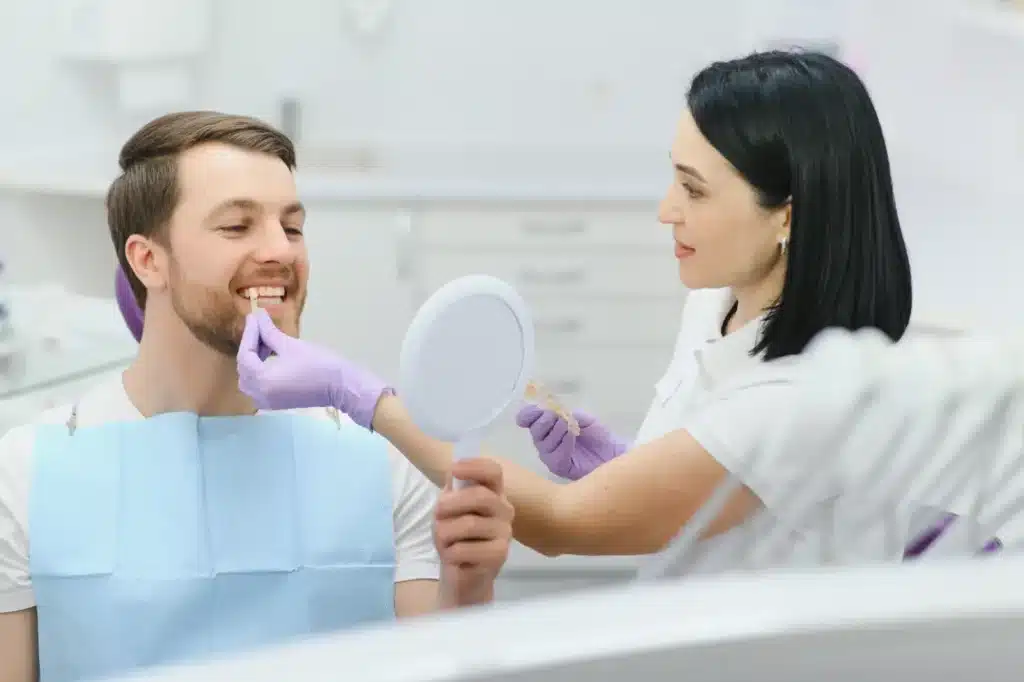
female client during slelection of teeth shade

How Dental Veneers Support Tooth Structure?

When a tooth is covered with a veneer, the extra layer can help reinforce the tooth underneath, shielding it from everyday damage and helping the veneer last longer. Research indicates that veneers not only improve the appearance of teeth but can also support the underlying tooth structure by reducing the chance of chips and cracks and helping the tooth better withstand daily biting forces.
The preparation process for a veneer can also remove weakened or compromised enamel, leaving a smoother, more even surface that is better able to cope with normal wear. This means veneers offer both cosmetic and functional advantages for patients who want a stronger, more attractive smile.
Having veneers placed is generally not painful, as the small amount of enamel removed from the front of the tooth is done using local anaesthetic.

Dental Porcelain Veneers Preparation

To get a tooth ready for a porcelain veneer, your dentist gently removes about 0.3 to 0.7 millimetres of enamel from the surface. This amount is close to the final thickness of the veneer that will be placed on the tooth.
Most of the enamel is removed from the front and biting edges of the tooth. An impression is then taken and sent to a dental laboratory, where a custom veneer is made for you.
porcelain implants
choosing dental shade for veneers

When Porcelain Veneers Are Used

Custom made porcelain veneers can be used to
  • Cover teeth that are badly stained
  • Mask teeth that are badly discoloured
  • Improve or change the shape and appearance of teeth

Types of Dental Veneers

A dental veneer is a thin layer of composite resin or porcelain that is bonded permanently to the tooth surface. The two most common options are composite veneers and porcelain veneers.

Composite Veneers

Composite veneers can offer similar cosmetic benefits to porcelain veneers, such as hiding cracks, chips, stains and small gaps. They are usually more affordable than porcelain veneers.
However, composite veneers are not as strong or long lasting as porcelain veneers. The advantage is that they often require little or no reshaping of the natural tooth before placement.

Porcelain veneers

Porcelain veneers are generally stronger and longer lasting than composite veneers. They usually have a smoother, glossier finish, bond very well to the tooth surface, and offer excellent aesthetics. Porcelain also resists staining and is gentle on the surrounding gum tissue, so porcelain veneers often outlast composite options.
They are a good treatment choice when decay or damage is quite extensive yet still relatively shallow, and when a composite veneer cannot restore the tooth properly.
Porcelain veneers are usually not reversible, so it is important to be sure before starting treatment. Each veneer is a very thin shell and can feel delicate on its own, but once bonded securely to the tooth enamel it becomes strong and stable.
This type of veneer is not suitable for everyone. It may not be ideal for people who frequently chew on objects such as pens or for patients who clench or grind their teeth, a condition known as bruxism.
veneers

CEREC veneers

CEREC technology, which stands for Chairside Economical Restoration of Esthetic Ceramics, allows your dentist to design and mill your veneers in the clinic during your visit. Because everything is completed on site, there is no need to send impressions to an external laboratory, so CEREC veneers can be a faster and more convenient option.

Zirconia veneers

Zirconia ceramic veneers are often recommended when a tooth is more heavily damaged. They are generally stronger than traditional porcelain veneers, so your dentist may choose them for back molars where extra strength is important to reduce wear. For the same reason, Zirconia crowns are now commonly used on back teeth for long lasting durability.
zirconium porcelain
snap on veneers

Temporary veneers (Snap On)

Snap On veneers are removable arches that sit over your natural teeth to temporarily change the look of your smile. You can take them in and out as needed, which makes cleaning and maintenance simple.
These veneers are also custom made so you can choose the shade and shape you prefer. They usually cost less than porcelain veneers, although they do not last as long. Snap On veneers can be a good choice for people who want a smile makeover but are not ready to invest in porcelain veneers.

Instant veneers

Instant veneers are ready made rather than fully customised. Your cosmetic dentist will select the closest match in shape and colour to suit your smile. They are usually more affordable than individually crafted porcelain veneers, although they are generally less durable and may not last as long.
dental veneers

Comparing the two most common types of veneers

veneer of a dental implant

Composite veneers

  • Very thin layers of material
  • Usually require less removal of natural tooth structure before placement
  • Treatment is typically faster than with porcelain veneers
  • Generally a more affordable option than porcelain

Porcelain veneers

  • Offer greater resistance to staining
  • Reproduce the look and translucency of natural teeth more closely
  • Typically stronger and longer lasting
  • Usually higher in cost than composite veneers
dental veneer

When might dental veneers be considered?

Veneers can be a possible solution for:
  • Crooked or misshapen teeth
  • Chipped or broken teeth
  • Small gaps between teeth
  • Worn or thinned enamel
  • Noticeable chips or cracks
  • Mildly uneven tooth alignment

Veneers to repair more significant chips

Minor chips and fractures can often be repaired with tooth-coloured composite fillings. When the damage is more extensive, veneers may provide a stronger and more aesthetic result.
Veneers are usually made from ceramic materials that resist staining and interact with light in a similar way to natural enamel. They can be polished and contoured so they blend in with surrounding teeth.Most of the enamel is removed from the front and biting edges of the tooth. An impression is then taken and sent to a dental laboratory, where a custom veneer is made for you.
dentist with color samples

Veneers for more severe discolouration

Many types of tooth discolouration respond well to professional whitening treatments, such as in-chair whitening or custom take-home trays. However, some deep or stubborn stains do not improve enough with whitening alone. In these cases, a veneer may be a better way to achieve a brighter, more even smile.
Very dark teeth can sometimes be challenging to fully mask even with porcelain veneers, so an assessment is essential. A cosmetic dentist can examine your teeth and advise whether veneers are the right option for your specific situation.

Dental Veneers Compared With White Fillings

Dental veneers are very thin, custom made shells that cover the front surface of the teeth. Because of the way they reflect light, veneers usually look more natural than standard white fillings. Their translucency is closer to real enamel, so the finished result can blend very smoothly with your smile.
difference in veneers and fillings

Shade Choice and Accurate Positioning of Veneers

High quality porcelain veneers made by experienced dental laboratories have excellent cosmetic qualities. They resist staining, hold their shine, and keep a glossy, healthy tooth appearance for many years. Achieving an exact colour match with a single porcelain veneer can be difficult, especially when it sits next to several visible teeth. For this reason, many cosmetic dentists suggest placing a group of veneers at the same time so the shade is consistent across the whole smile line.
Your dentist may recommend veneering several neighbouring teeth together. Placing veneers one by one can make it harder to match the colour later, which may cause a newer veneer to stand out when you smile.
Veneers are not the ideal solution for every concern. A tooth that is very dark or heavily discoloured, for example, may not reach the desired shade with a veneer alone. The success of any treatment depends on how severe the underlying problem is and on the condition of the tooth structure.
To understand which option is best for you, it is important to have a personalised assessment. Contact Dental Nook to book a consultation and find out whether dental veneers are a suitable choice for your smile.

Veneers versus dental crowns

Compared with dental veneers, dental crowns usually involve removing much more of the natural tooth. For many people who want to improve the look of their smile without a large reduction in tooth structure, porcelain veneers can be a more conservative option.
Porcelain veneers are carefully planned and individually made to match the colour, size and shape you want for your teeth. While a crown generally covers about 40 to 50 per cent of a tooth, a porcelain veneer only alters around 3 to 5 per cent of the surface, which is roughly ten times less than a crown.
difference in veneers and crowns

How much do porcelain veneers cost?

Porcelain veneers typically range from about $500 per tooth to more than $2000 per tooth. Just like natural teeth, they need excellent daily care, including brushing, flossing and regular dental visits.
Although porcelain veneers are strong, it is still important to be cautious with very hard foods and to avoid habits such as teeth grinding where possible.
Composite veneers are shaped directly onto the teeth. The dentist layers and sculpts the composite material on the front surface of the teeth, often completing the treatment in a single visit.
When placed correctly, composite veneers can provide a similar improvement in the appearance of your smile compared with porcelain veneers, although the materials and longevity are different.

Request an Appointment Online

Please note that this is not an actual appointment, but only a request for one. We Will Contact you for a confirmation shortly after. Thank you!